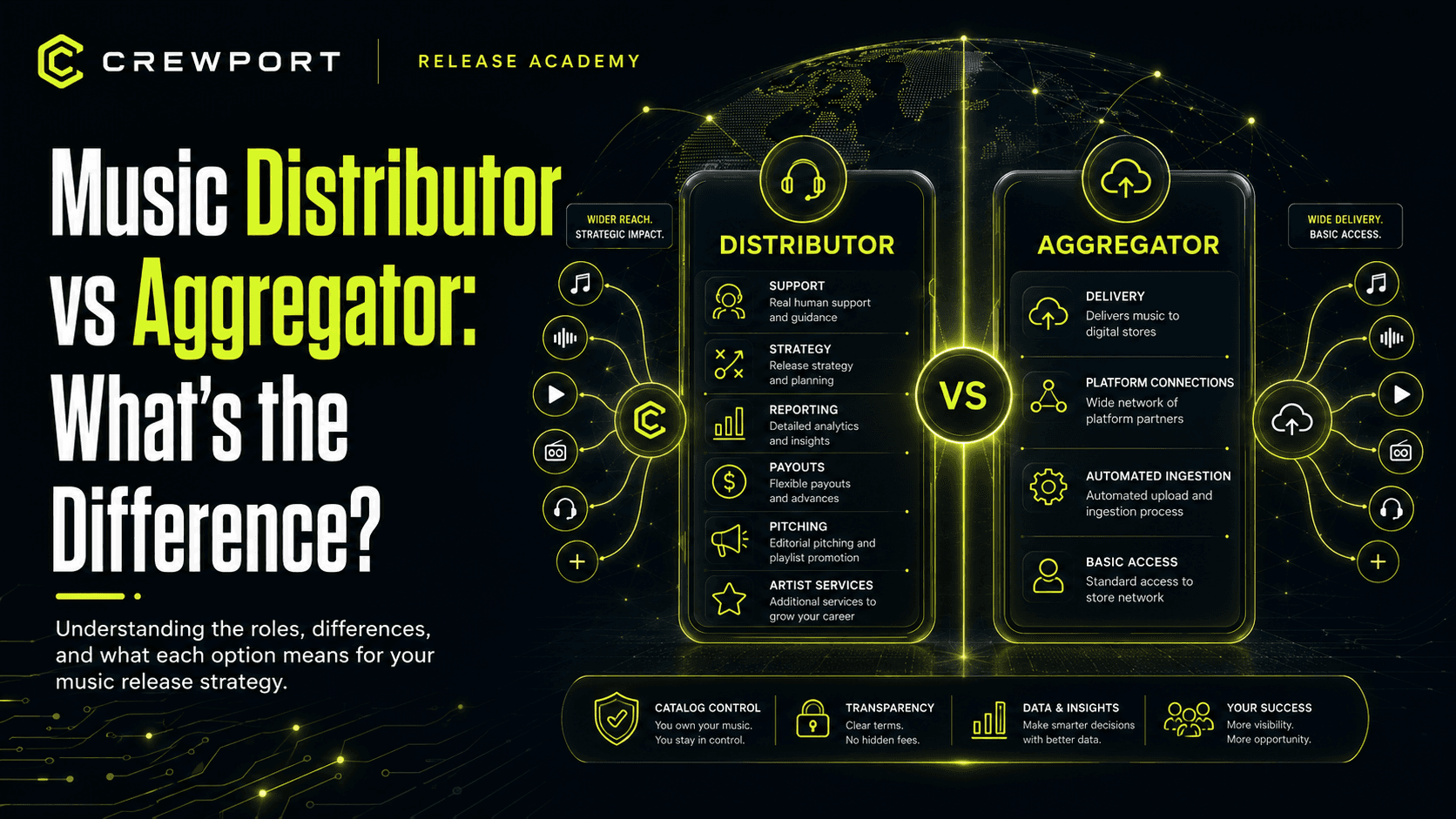
If you've spent any time researching how to get your music onto streaming platforms, you've probably seen both terms — distributor and aggregator — used to describe the same companies. Sometimes interchangeably. Sometimes as if they mean completely different things.
Here's what the distinction actually is, why it matters less than it used to, and what to focus on instead when choosing where to release your music.
The original distinction
In the traditional music industry, a distributor was a company with direct licensing relationships with retailers and platforms — physical stores, digital storefronts, and eventually streaming services. Distributors were typically connected to or owned by major labels, and they worked with established labels and artists who could meet volume and revenue thresholds.
An aggregator was a different kind of company — one that aggregated releases from many independent artists and delivered them to platforms in bulk, without requiring the artist to have a direct licensing relationship of their own. Aggregators made digital distribution accessible to anyone, not just signed artists.
The classic examples: CD Baby and TuneCore, when they launched in the early 2000s, were aggregators. They didn't own distribution infrastructure themselves — they delivered through established distributors who had the platform relationships.
Why the distinction matters less today
The lines have blurred significantly. Most companies that independent artists interact with today operate as both — they have their own direct delivery agreements with major platforms and they aggregate releases from a large number of artists.
When an independent artist signs up for DistroKid, TuneCore, CD Baby, or CrewPort, they're working with a company that has direct platform relationships and delivers releases under its own agreements. Whether you call that distribution or aggregation is largely semantic at this point.
What actually matters is not the label — it's the substance of what the company does for your release.
What to focus on instead
Rather than getting caught up in terminology, evaluate any distribution company on the things that actually affect your release:
Direct platform relationships Does the company deliver directly to Spotify, Apple Music, and other major platforms under its own agreements — or does it use a third-party intermediary? An extra layer in the delivery chain can mean slower delivery, less control over metadata, and more distance between you and a resolution when something goes wrong.
Metadata handling Does the platform check your metadata before submission or pass it straight through? A direct relationship with platforms typically means faster communication when a metadata issue triggers a rejection.
Royalty collection Are royalties collected directly from platforms and paid to you — or does the money pass through multiple hands before it reaches your account? Each intermediary in the chain can add reporting lag and potential discrepancy.
Support and problem resolution When a release is rejected, delayed, or incorrectly credited, can you reach someone who can actually fix it — or are you one ticket in a queue of thousands? This is often where the difference between larger aggregators and more focused distribution platforms becomes most visible.
Where the term "aggregator" is still useful
The term aggregator is still sometimes used meaningfully in two contexts:
Sub-distributors Some smaller distribution services don't have direct platform relationships — they aggregate releases and send them through a larger distributor. If your distribution company is a sub-distributor, your release goes through an extra layer before it reaches Spotify. This isn't necessarily a problem, but it adds time and distance to the delivery chain.
Publishing aggregators In publishing, an aggregator has a specific meaning: a company that collects mechanical royalties on behalf of songwriters and publishers from digital platforms. This is entirely separate from master recording distribution. If you write the music you release, you need both — a distributor for your recordings and a publishing administrator for your compositions.
The question that actually matters
Instead of asking "is this a distributor or an aggregator," ask:
- Does this company have direct delivery agreements with the platforms I care about?
- Does it check my metadata before submission?
- Can I see store-by-store delivery status?
- How transparent is the royalty reporting?
- What happens when something goes wrong?
The answers to these questions tell you far more about whether a company is the right fit for your release than any label it applies to itself.
Common mistakes
- Choosing a distribution company because it calls itself a "distributor" rather than
evaluating what it actually does - Not asking whether a smaller or newer service uses a sub-distributor for delivery —
which can add time and complications to your release - Confusing master recording distribution with publishing administration and missing
out on composition royalties entirely - Assuming that a company with direct platform relationships automatically provides
better service — scale can work against individual artist support
CrewPort workflow tip
When evaluating any distribution service, ask specifically about the delivery chain: does your release go directly to Spotify and Apple Music under the company's own agreements, or through a third party? CrewPort delivers directly to major platforms under its own agreements — which means faster delivery, direct metadata communication, and no extra layer between your release and the platform when something needs to be resolved.
FAQ
Does it matter whether I use a distributor or aggregator for my royalties? What matters is whether royalties are collected directly from platforms and paid to you in full on a clear schedule — not the label. Ask any service you're considering how royalties flow from platform to your account, and how long the reporting lag is.
Can I use an aggregator and a distributor at the same time? You can use different services for different releases, but you cannot distribute the same release through two services simultaneously. That creates rights conflicts on the platforms that can result in your release being taken down or monetized incorrectly.
What is a publishing aggregator and do I need one? A publishing aggregator — also called a publishing administrator — collects mechanical royalties from digital platforms on behalf of songwriters. If you write the music you release, your compositions earn royalties separately from your recordings. A distribution service handles recording royalties; a publishing administrator handles composition royalties. You likely need both.
Do sub-distributors affect how my music is delivered? Potentially. A sub-distributor adds a step to the delivery chain, which can mean slower delivery, less direct communication with platforms about errors, and additional reporting lag. It's worth asking any smaller distribution service whether it delivers directly or through a third party.
Is DistroKid a distributor or an aggregator? By the original definition, DistroKid started as an aggregator. Today, like most major independent distribution services, it has direct delivery relationships with major platforms. The distinction is largely historical at this point.
What's the difference between a digital distributor and a record label? A record label signs artists, funds recordings, owns or controls master rights, and takes a share of income in exchange for investment and promotion. A distributor delivers recordings to platforms and collects royalties — without owning your music or taking a percentage of your career. With most independent distributors, you retain full ownership of your masters.
Last updated: May 2026
Want distribution built around getting your release right, with direct delivery to every major platform? Apply for Early Access →