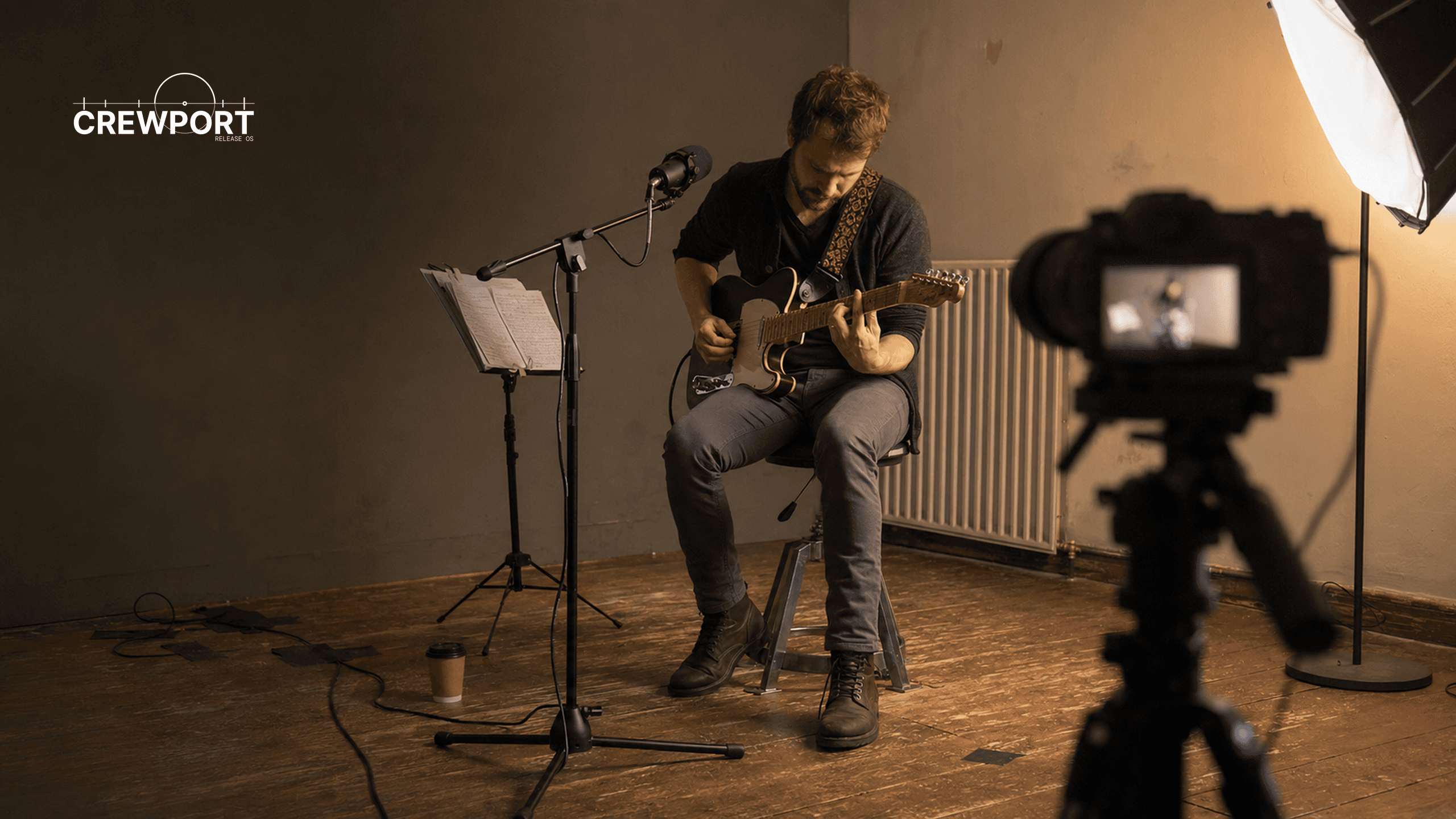
An independent artist spends three months making a music video. The finished film goes to YouTube. Short edits go to Instagram and TikTok. Meanwhile the audio sits on Spotify, where most of that artist's actual listeners are streaming the song without ever seeing the visual world built around it.
Spotify is trying to close that gap. On June 17, 2026, it began letting selected artist and label teams upload full-length videos directly through Spotify for Artists — official music videos, live performances, studio sessions, covers. Those videos can generate royalties and may qualify for Spotify charts. By July 21, Spotify said the beta had reached nearly 100,000 artists, and it added editorial video pitching plus its first global music-video chart.
This is a real product shift, not a cosmetic one. Spotify has stopped treating video as decoration wrapped around an audio stream and started building a separate delivery, discovery and monetization layer inside the listening experience.
Which is worth taking seriously — and also worth resisting the obvious trap: manufacturing another expensive piece of content just because a new upload button appeared.
What actually changed
Labels and participating distributors could already deliver music videos to Spotify, and that's still the platform's primary delivery route for audio and video releases. The beta adds a second option: team members with Admin or Editor access can upload a video themselves from the Video & Visuals section of Spotify for Artists on desktop.
Per Spotify's current upload instructions, a direct upload has to be:
- focused primarily on music;
- longer than 30 seconds;
- shorter than 20 minutes;
- landscape, preferably 16:9;
- at least 1920 × 1080;
- under 50 GB.
Accepted right now: official music videos, live performances, studio or acoustic sessions, and cover performances. Not supported in the beta: visualizers, lyric videos, multi-song concert films, and videos without music.
Once a video is through, it can surface in your profile's Video tab, the Now Playing view, release pages, Home, editorial video playlists, the personalized Videos For You experience, and fan notifications. Spotify says processing can take up to 24 hours, with analytics generally arriving about 24 hours after publication.
Access is still limited. If you don't see the feature, you can join Spotify's waitlist or keep delivering eligible videos through a label or distributor.
Video streams can earn royalties — read that carefully
Spotify says videos longer than 30 seconds can earn royalties and may be chart-eligible in the same way qualifying audio is.
That sentence needs unpacking, because it's the one most likely to get over-read. It confirms that a full-length video is monetizable content on Spotify. It does not establish a per-view price, promise a particular payout, or show that video earns more than the same audience streaming the audio. As with audio, you're not paid a fixed retail rate — money moves through the relevant recording and publishing relationships, and the amount attached to any individual stream varies.
Your video may also be eligible for Music Video Charts Global, a daily ranking of the 50 most-streamed music videos worldwide. Official music videos and live-performance videos can qualify whether they arrive via an eligible distributor or through Spotify for Artists.
Treat the chart as a discovery surface, not a target. A video can be commercially useful while finishing nowhere near a global Top 50.
Spotify's real argument is what happens after the video
The interesting pitch isn't revenue from the video itself — it's viewer behavior afterward.
Spotify reports that listeners who stream a full-length video play the associated song 64% more over the following three weeks than comparable listeners who only heard the audio. It also says video viewers are 1.4× more likely to save, share or playlist the song, and stream 57% more of the artist's wider catalog.
These are Spotify's own platform findings, and they describe behavior observed inside Spotify — not proof that uploading a video will produce the same lift for you. There's an obvious selection effect worth naming: fans who choose to watch a full performance are probably already more invested than someone hearing a track passively in a playlist. Genre, audience size, video quality and placement all move the numbers too.
That said, the mechanism is plausible. A listener who watches you perform gets context an audio stream can't deliver — a face, a physical presence, a visual identity, and often a clearer reason to try the next song.
Spotify offered a specific case: after viewers watched indie-rock band The Runarounds perform "Valerie (Live from The Minivan Tour)," those viewers streamed 67% more of the band's catalog across 21% more distinct tracks than audio-only listeners, and super listeners streamed the artist 70% more. Again — Spotify-reported, not independently audited. It's still more useful than a raw view count, because it measures movement into the catalog rather than attention to one asset.
You pitch the video separately from the song
Eligible music videos can now be pitched to Spotify's editorial team, and this is the operational detail teams miss: the video pitch is separate from the song pitch. Releasing an audio track plus an official video means two distinct editorial submissions.
A video can currently be pitched when it's:
- an official music video or performance video;
- unreleased, or released within the previous seven days;
- delivered through a label or distributor, or uploaded directly through Spotify for Artists.
The seven-day window is calculated differently depending on the route: direct uploads use the upload date, distributor-delivered videos use the stated release date.
You can pitch multiple eligible videos at once, but there's only one pitch per video — so it's worth writing properly. The form asks for the video's story, genre, mood, visual style and marketing plans. Placement is never guaranteed. Possible destinations include editorial collections like Best New Videos, Live Performances and Today's Top Videos; Spotify says it now runs more than 100 video playlists globally.
The practical takeaway is unglamorous: upload before your campaign is over. A video delivered weeks after its public premiere can still matter to fans, but it has already missed the pitching window.
The US publishing requirement is the easiest thing to miss
Owning the video file and the master does not clear the underlying composition. This is where release day goes sideways.
Spotify says it relies on songwriter and publisher ownership information registered with The Mechanical Licensing Collective to determine whether a music video is eligible for streaming in the United States — a process entirely separate from delivering the video.
For US availability, Spotify currently instructs every songwriter on the underlying work to:
- register with The MLC;
- register the musical work with The MLC;
- opt in to Spotify's Direct Audiovisual Licensing Agreement, administered through the Harry Fox Agency.
Where a songwriter has an exclusive publishing deal, the publisher may handle those steps. Spotify says it can take up to seven days after completion for a video to become enabled in the US.
Picture how that fails: your video is accepted, live and playing fine in other markets, and completely unavailable to US viewers because one co-writer's publishing data or audiovisual authorization is incomplete. Nobody flags it in advance. So check every writer before you schedule the premiere — not after.
A cover video needs more than a cover recording
The beta accepts cover performances and lets you link both the original song and, where relevant, your own released cover recording. That convenience can create a false sense of clearance.
An audio cover license is not universal permission for an audiovisual use. In the US, compulsory mechanical licensing generally covers making and distributing an audio recording. Synchronizing a composition with moving images has traditionally required separate permission from the composition owner, unless a platform-specific licensing arrangement covers that use. So confirm how Spotify's direct audiovisual agreement applies to your work and your territory rather than assuming the license behind your audio cover solves the video.
The same caution applies to everything else living inside a video:
- samples embedded in the master;
- archive footage;
- stock video, fonts and photographs;
- choreography or staged material protected by third-party rights;
- identifiable artwork or trademarks;
- performers, actors and locations;
- session-musician or featured-artist agreements;
- footage originally commissioned under a limited-use production contract.
A distributor approving your audio release proves nothing about whether the video is cleared.
Direct upload or distributor delivery?
The new route doesn't automatically replace video distribution. Each path has a shape it fits.
Direct upload through Spotify for Artists may suit you when:
- you already have beta access;
- the video is primarily intended for Spotify;
- your team wants to schedule and manage it hands-on;
- it's a straightforward live or studio performance;
- your distributor doesn't currently deliver video to Spotify.
Label or distributor delivery may be better when:
- the same video is going to several music services;
- you need centralized metadata and royalty reporting;
- your catalog contains many videos;
- there's already an established video-delivery workflow;
- broader territorial availability matters.
One asymmetry to know before choosing: Spotify's own documentation notes that directly uploaded and distributor-delivered videos can have different country availability during the beta. Distributor-delivered music videos are currently available to Premium listeners across a broader published list of territories, while direct-upload availability stays more limited and may vary.
And ask the boring question that decides most of this: who maintains this asset in two years?
Where CREWPORT fits
Whatever route you pick for the video, the audio side has to be clean first — the video links to a recording, and that recording needs correct ISRCs, consistent artist naming and validated metadata before any of this works properly. CREWPORT validates that before delivery and keeps your identifiers and artist-profile IDs attached to every release. For the video file itself, confirm directly with your distributor whether it currently delivers video to Spotify, since coverage differs between providers — and if it doesn't, the direct-upload route exists for exactly that case.
You probably don't need a cinematic video
A new distribution surface has a way of quietly becoming a new production expense.
It would be a strange lesson to conclude you now need a $20,000 narrative film for every single, from a feature that explicitly accepts studio sessions, acoustic performances and live recordings. A strong one-room performance often reveals more about an artist than an ambitious concept buried under rushed execution.
Three levels worth considering, in ascending cost:
- Performance capture — one carefully lit live take with clean audio and intentional framing.
- Studio version — a session, alternate arrangement or stripped performance that gives existing listeners something genuinely different.
- Official video — a narrative or visual concept, justified by the importance of the release and the budget actually available.
What not to do: upload a horizontal version of a disposable social clip just to fill the Video tab. Full-length viewing demands pacing, sound and visual continuity that short-form content gets to skip. The video should either reward someone who already likes the song, or give a curious listener enough reason to remember you.
Build video into the release timeline
Before production
- confirm the concept and the total budget;
- identify every composition and recording used;
- secure performer, location and footage permissions;
- confirm songwriter and publisher information;
- decide whether Spotify delivery will be direct or distributor-led.
Before release
- create a 16:9 master at 1920 × 1080 or higher;
- keep the file inside Spotify's current limits;
- obtain a separate video ISRC where appropriate;
- verify the linked audio recording;
- prepare an accurate title, version and original release date;
- complete the US publishing and audiovisual-clearance steps;
- choose a thumbnail that actually works small;
- upload early enough for processing and corrections.
During the campaign
- pitch the song and the video separately;
- publish the strongest excerpt on social platforms;
- point your existing Spotify listeners toward the video, not just the audio;
- watch video streams, listeners and follow-on catalog activity;
- compare the result against what the production cost and what it was for.
That last line matters more than the view count. A video with modest direct viewing can still be a success if it lifts saves, repeat listening, follows or deeper catalog exploration.
FAQ
How long can a Spotify music video be?
Longer than 30 seconds and shorter than 20 minutes, landscape, preferably 16:9, at least 1920 × 1080, and under 50 GB. Multi-song concert films aren't supported in the beta.
Do videos on Spotify earn royalties?
Spotify says videos over 30 seconds can earn royalties and may be chart-eligible like qualifying audio. There's no published per-view rate — payment flows through your recording and publishing relationships, and per-stream amounts vary.
Why is my video unavailable in the United States?
Most often because the publishing side isn't complete. Spotify uses songwriter and publisher data registered with The MLC to determine US eligibility, and every songwriter also needs to opt in to Spotify's Direct Audiovisual Licensing Agreement via the Harry Fox Agency. Completion can take up to seven days to take effect.
Can I upload a cover song video?
The beta accepts cover performances, but an audio cover license isn't automatically permission for audiovisual use. Confirm how Spotify's direct audiovisual agreement applies to that composition and territory before you upload.
Do I pitch the video and the song together?
No — they're separate submissions. A video is pitchable if it's unreleased or released within the previous seven days, measured from the upload date for direct uploads and the stated release date for distributor-delivered videos.
Should I upload directly or go through my distributor?
Direct suits Spotify-first videos and simple performance captures when you have access. Distributor delivery suits multi-platform videos, larger catalogs and centralized reporting — and during the beta it currently reaches a broader list of territories.
Video is becoming part of music distribution
Spotify is making a deliberate claim here: video belongs inside the music product, not only on a separate video platform. For independent artists that's another real discovery route — and also more delivery decisions, metadata, publishing administration, rights clearance and campaign work.
So use the opening with judgment. If you already have a good official video, performance or studio session, delivering it to Spotify is getting hard to justify skipping. If you don't have a suitable visual, make something the song can support and the budget can survive. The upload button is new; the standard isn't. The asset still needs a purpose.
Get the audio side right first
Every video links back to a recording — and if that recording has inconsistent artist naming, a regenerated ISRC or incomplete metadata, the video inherits the problem.
CREWPORT validates your metadata before delivery and keeps your ISRCs and artist-profile IDs attached to every release, so what you build on top of it actually connects.
Sources
- Spotify for Artists — Upload Full-Length Videos Directly, June 17, 2026
- Spotify for Artists — How Video Takes Fans Further, July 21, 2026
- Spotify Support — Uploading Videos in Spotify for Artists
- Spotify Support — Pitching Music and Videos to Playlist Editors
- Spotify Support — Music Videos on Spotify
- Spotify Support — Music Video Publishing Rights and Clearances
- The MLC — Registering Musical Works